“Memory Is a System, Too.”
A Conversation with T’val E’shen
Global Horizons Interview Series – May 24
Location: Freehold Gardens, shaded seating beneath the orchard pergola
Interviewer: Dr. Noor Aziz
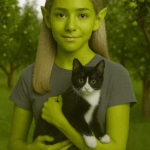
Subject: T’val E’shen, V’ren xeno-biologist, planetary integration specialist
DR. NOOR AZIZ:
T’val, thank you for stepping away from the analysis suite to speak with us today.
T’VAL E’SHEN:
It’s a welcome reprieve. The gardens remind me that ecosystems can be cultivated outside a lab—if one is patient with chaos.
NOOR:
You’ve spent much of your time since landing examining both V’ren and human biosamples. What are you looking for?
T’VAL:
Patterns of compatibility, points of divergence. We are both seeded species developed on parallel lines of different planets. Yet here we are—interfacing, cross-pollinating, bonding. I study what happens when legacy biology collides with possibility.
NOOR:
You make it sound romantic.
T’VAL:
It is. So is domestication. So is symbiosis. All survival is intimate. The question is more personal for me; my possible mating pool was always limited, largely because of political alliances, but here I am able to explore more possibilities.
NOOR:
And does that intimacy pose risks?
T’VAL:
Yes. The same way oxygen is corrosive, and sunlight mutates DNA. But the absence of contact would have killed us more slowly.
NOOR:
You’ve said before that memory is a biological system. What did you mean?
T’VAL:
We think of memory as mind—but in truth, every cell remembers. Trauma leaves protein markers. Trust repairs tissue faster. Children born in peace develop differently than those born in fear. Memory is not metaphor. It is measurable.
NOOR:
How has Earth changed your view of life?
T’VAL:
I once believed that complexity was the highest form of evolution. Earth reminds me that resilience is the truer measure. This world endures grief by rooting it in story—and harvesting from it new myths. That may be the most important adaptation of all.
NOOR:
Last question. Tonight’s celebration marks a turning point for the Freehold and for interspecies relations. What are you hoping for?
T’VAL:
That we dance. That we forget, for a few hours, the wound that brought us here. And in doing so, lay down new layers of memory—gentle ones—that may someday become the foundation of something enduring.
NOOR:
Thank you, T’val. That’s beautifully said.
T’VAL:
It is a beautiful evening. We should not waste it.