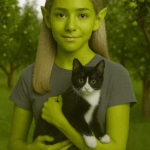
“We Build the Sparks That Hold It All Together.”
A Family Interview with Kalir Son and Beti Shan
Global Horizons Interview Series – May 14
Location: North Generator Compound, Marmaduke Freehold
Interviewer: Arjun Kaviraj, Global Horizons Field Correspondent
Subjects: Kalir Son (electrical engineer, age 58), Beti Shan (fabrication specialist, age 51), and their eight children: Serin (18, neural interface technician), Dava (16, engineering student), Renn (15, medical technician), Olven (13, engineering student), Teli (12, errands runner), Kara (11), Bina (10), and Lo (7)
ARJUN KAVIRAJ:
Kalir, Beti, thank you for inviting me to your work shelter. I believe this counts as both home and shop for now?
Transcript: Global Horizons Interview Series, Day 4
Location: Work Shelter near Freehold Fabrication Zone
Host: Arjun Kaviraj, Global Horizons Field Correspondent
Subjects: Kalir Son (electrical engineer), Beti Shan (fabrication specialist), and their eight children: Serin (18), Dava (16), Renn (15), Olven (13), Teli (12), Kara (11), Bina (10), and Lo (7)
ARJUN KAVIRAJ: Kalir, Beti, thank you for inviting me to your work shelter. I believe this counts as both home and shop for now?
KALIR SON: For now, yes. I am not sure how it got the name airstream but we like it. We are in the middle of remodeling the large apartment above the shop floor.
We have really enjoyed the opportunity to work with our hands and sort of tools many in our trades have only ever read about. My eldest says the sparks smell different here. Earth metal has a taste to it.
BETI SHAN: It’s not just the taste. Earth humidity changes weld behavior. Fabrication takes more coaxing. I think of it as courting the metal. On ship, you command it. Here, you negotiate. I enjoy working in Lord Marmaduke’s shop. I understand the tooling, and I love making or repairing something with my hands instead of just entering an item number and waiting for the printer. That process works. But it’s not as satisfying.
ARJUN: You both have very technical trades. How have you adapted your skills to Earth systems?
KALIR: Slowly. Converting equipment from a Base-12 system to work with a Base-10 power grid is challenging. Some things convert efficiently. Others? Not so much. Earth circuits are stubborn, and your transformers are absurdly delicate. But I’m learning. Lord Marmaduke gave me a full library of electrical blueprints and three humans who never stop asking questions. They don’t have my schooling, but they are curious—and that makes them the best kind of engineers.
BETI: I’ve joined a local engineering project where teams compete at something called a tractor pull. It’s a fun challenge for a fabricator, and I think I’ll enjoy it.
ARJUN: Your children span ages seven to eighteen. How have they handled the shift from orbital to terrestrial life?
KALIR: Serin, our eldest, adapted quickly. She works as a neural interface technician at the fire station. Dava is following us into systems work. Renn leaned toward medicine—he says pain has color here. That Earth wounds bleed differently in this gravity and pressure.
BETI: Olven is apprenticed in engineering. He helps assemble micro-generators for the farm grid. Teli has become Eliot Reyes’ shadow. She knows every trail and which chickens pretend to be lost for attention. The youngest three? They belong to the world now. They tumble with the Reyes children and learn dances that bruise their ankles.
ARJUN: Let’s talk about something more personal. V’ren culture doesn’t traditionally bond couples unless there is a pregnancy. Is that still true?
KALIR: Under V’ren law, you are not bonded until conception is proven. I didn’t even know I was on Beti’s list of potential mates for over a year. We were friends—she printed my circuit designs. One night, while waiting on a device to finish, she invited me to get food. Instead of dinner, she chose me. The part never got made—but Serin did.
BETI: And after that? He became a father. Which meant he stayed home. Taught the babies. Fed them. Walked with them. V’ren men don’t often work outside the home until school age is reached. That’s our tradition.
KALIR: It wasn’t a sacrifice. It was formation. I helped shape eight children. What greater work could there be?
ARJUN: And now that the younger children are in school?
KALIR: Those years gave me time. I took classes, slowly. Now I hold the equivalent of three Earth PhDs—electrical engineering, computer science, and literature, which I took up after Serin was born. When I returned to full-time work, I already knew the system and the people. I started in power grid management. Now, Serin and Dava are thinking about their futures—and I’m here to keep the lights on.
BETI: I finally have a chance to expand what I do. Earth has competitions where we test our skills and push limits. It’s not about the money—it’s about proving something to yourself.
ARJUN: What’s been the biggest cultural shock for your family?
SERIN (18): That humans talk during meals. Loudly. With opinions. No one waits for rank. They just share. I love it.
DAVA (16): Boys and girls mix constantly. Back home, there were clear lines. Here? Everyone debates. Everyone dances. I like it.
RENN (15): I worry if I’ll ever be a father. The girls say human boys are more exciting. That hurts.
OLVEN (13): Earth gravity makes tools fall harder. Kids challenge you to prove strength, then run.
TELI (12): I run errands with Eliot. He taught me to jump fences. No one tells me I’m too loud. I love that.
KARA (11): We learned tinikling. I hit my shin, then someone else’s. He tried to kiss me. Human boys are different.
BINA (10): Human math is funny—but it makes snacks easier to count.
LO (7): Chickens are weird. But tasty.
ARJUN: Have the older children begun shaping their futures?
SERIN: I enjoy helping people understand hard things—even when it hurts.
DAVA: I want certification from the machinists’ union. Proof of skill, not caste.
RENN: I want to work emergency medicine. Be where it hurts first.
OLVEN: I want to build things no one notices—until they break. Then fix them.
TELI: I want to run things—routes, people, plans. Like Eliot. But better.
KARA: I want to dance, always. I want to learn every style.
BINA: I want to make snack math a job.
LO: I want to drive one of the vans that makes fried chicken.
ARJUN: What do you miss most from the ships?
KALIR: The rhythm of air through the hull. Like breath.
BETI: The rhythm of it all. But I’m learning to love the chaos.
SERIN: My friends who didn’t survive.
DAVA: The blue-white nav panel glow. Everything felt clean.
RENN: Gloves that always fit.
OLVEN: Microgravity. It was magical.
TELI: The click-snap of doors.
KARA: My friends—both the lost and the distant.
BINA: The recyclers. Here, we bag things. There, we broke them down.
LO: Knowing what came next.
ARJUN: And what have you come to love about Earth?
KALIR: That tools rust if you don’t use them. It forces commitment.
BETI: Wood. It smells like stories. I want to work with it.
SERIN: People ask my opinion. Also, the flirting.
DAVA: No one cares what caste you were—only your work.
RENN: That patients cry. It makes me want to help more.
OLVEN: That humans compliment work out loud.
TELI: That I get to plan and run, and no one says, “Pick just one.”
KARA: That people clap—even when you mess up.
BINA: That math leads to snacks.
LO: That chickens don’t mind if you talk to them while you eat them.
ARJUN: Final question. If this were your last interview, what would you want to say?
KALIR: Teach what you know. Share what you build. Ask what others need.
BETI: Let your children see you struggle—and how you keep going.
SERIN: Learn something new every day.
DAVA: Enjoy life.
RENN: Honor the dead, but celebrate the living.
OLVEN: Fasten what will carry weight. Let go of what won’t.
TELI: Say yes to something new. Then figure it out.
KARA: Dance through the pain. Make it part of the rhythm.
BINA: Be kind. Even your math teacher needs a snack.
LO: Chickenjoy is life.
ARJUN: Thank you, Son-Shan family. May your lights stay bright, your welds hold, and your chickens remain loyal.
BETI: Peace to your table.
KALIR: And power to your shelter.