Beacon Network – Node Types
Original Progenitor Beacons
- Form Factor: ~15 m × 35 m cylinder — dense, elegant, and almost featureless from the outside.
- Performance: 100% baseline throughput. Consistent, near-instant routing in dense lanes.
- Core Components:
- Singularity Core — unknown exotic construct generating the FTL propagation effect.
- Phase Seed Array — controls link formation and hop alignment.
- Durability: Designed to last tens of thousands of years with minimal maintenance.
- Placement: Often in deep, stable orbits or Lagrange points, sometimes anchored inside protective stations.
- Control AI: Fully autonomous and capable of high-precision navigation support — including autolanding for city-class vessels.
Salvaged / Rebuilt Beacons
- Form Factor: ~50 m × 250 m — roughly 40× the volume of an original due to extensive scaffolding, oversized field stabilizers, and protective armor.
- Performance: ~10% throughput of an original; slower routing and fewer parallel channels.
- Core Fragment: Contains a functional but incomplete singularity core recovered from a destroyed or degraded original.
- Reason for Size:
- Missing Progenitor subassemblies replaced with bulky modern substitutes.
- Housing includes large crew access areas, redundant power, and active debris defense systems.
- Service Life: 5,000–20,000 years if maintained and sheltered from major impacts.
- Failure Modes:
- Cumulative kinetic damage from micrometeors and orbital debris.
- Rare catastrophic strikes from large asteroids or deliberate attack.
- Over thousands of years, outer shielding erodes and signal handling modules degrade.
- Placement Strategy: Often installed in slower, low-priority corridors or as replacements in previously “dark” regions. Usually set in sheltered orbits with debris mitigation measures.
- Navigation Aids: Limited — enough for hazard mapping and basic traffic control, but insufficient for precision autoland of massive craft.
Strategic & Cultural Implications
- Patchwork Mesh: The galaxy’s comms map has lanes that have been slow for thousands of years, shaping trade and political borders.
- High-Value Assets: Even a 10% salvaged node can reconnect entire regions to the network, making them worth enormous diplomatic and military effort to defend.
- Corridor Politics: Factions vie for access to intact originals for faster travel; control of even one node can shift regional power.
- Maintenance Culture: Skilled crews who can keep salvaged units running are respected specialists, often serving neutral guilds or corporate coalitions.
- Archaeological Gold: Even damaged components of a destroyed beacon are priceless for study or reuse.
Beacon Network – Message Times (Updated)
Assumptions: Distributed nodal mesh with fast trunks and slow spokes. Times are typical 1-way (“ping”) and round-trip (RTT) under normal load; expect jitter.
| Route | Corridor Class | 1-Way Time | RTT | Effective Speed |
|---|---|---|---|---|
| Earth ↔ Lunar Node | Trunk (dense) | 0.01–0.05 s | 0.02–0.10 s | 500–2,500c |
| Earth ↔ GEO / Lagrange Subnodes | Trunk | 0.02–0.10 s | 0.04–0.20 s | 250–1,250c |
| Earth ↔ Mars Orbit | Trunk | ~0.5 s | ~1.0 s | ~1,440c |
| Earth ↔ Jupiter Orbit | Trunk | ~6 s | ~12 s | ~480c |
| Earth ↔ Neptune Orbit | Trunk/Mixed | 15–30 s | 30–60 s | 480–960c |
| Earth ↔ Kuiper Belt (avg) | Mixed | 20–40 s | 40–80 s | 600–1,200c |
| Earth ↔ Barnard’s Star (~4.25 ly) | Trunk (healthy) | ~5 days | ~10 days | ~310c |
| Earth ↔ Alpha Centauri (~4.37 ly) | Trunk (healthy) | ~5.15 days | ~10.3 days | ~310c |
| Earth ↔ 10 ly (good trunk) | Trunk | ~11.8 days | ~23.6 days | ~310c |
| Earth ↔ 10 ly (degraded lane) | Slow/Degraded | 18–46 days | 36–92 days | ~200–80c |
| Earth ↔ Alphecca / α CrB (~75 ly) | Sparse/Slow | ~138 days | ~276 days | ~198c |
| Earth ↔ Galactic Center (~26k ly) – Direct | Sparse | ~520 years | ~1,040 years | ~50c |
| Earth ↔ Galactic Center (~26k ly) – Optimized bounce | Multi-trunk | ~130 years | ~260 years | ~200c |
Corridor Classes
- Trunk (dense): Intact original beacons, low jitter, high capacity. ~300–400c interstellar, 400–1500c intra-system.
- Mixed: Originals + salvaged, occasional bottlenecks. ~150–300c long-haul.
- Sparse/Slow: Few originals, salvage-heavy, longer hops. ~50–200c.
- Dark: No viable route or intentionally disabled.
This makes the Galactic Core interesting strategically:
- Direct link is slow (good for archival or low-priority traffic).
- Indirect link is 4× faster if you can get priority passage through multiple high-demand trunks.
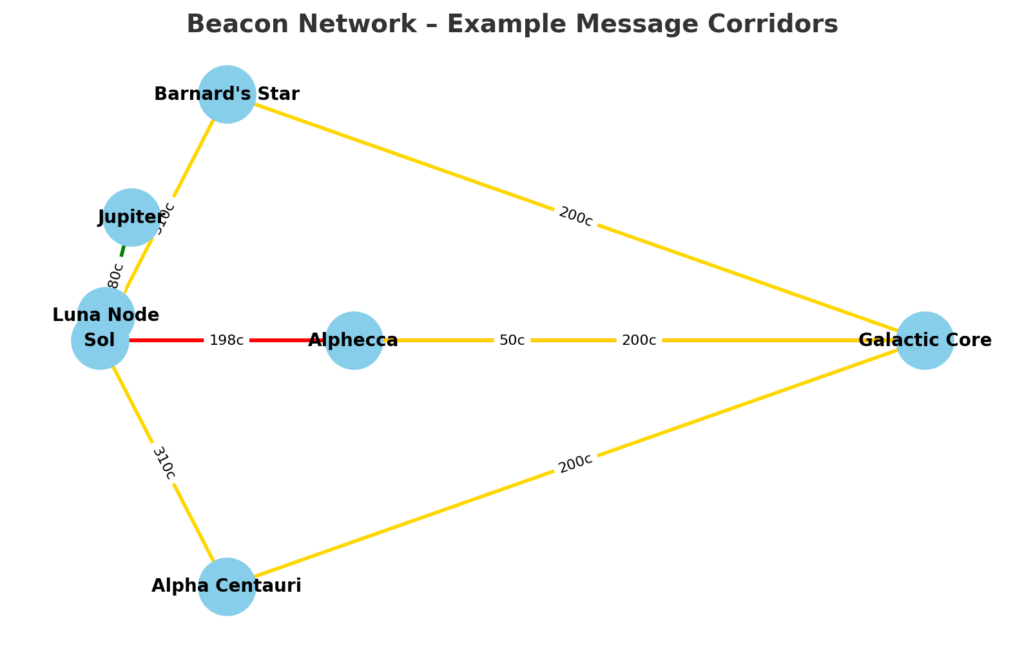
- Green = dense, high-speed trunks
- Gold = mixed-speed bounce routes
- Red = sparse/slow corridors

Pingback: The Beacons Wake — Matt Of Missouri