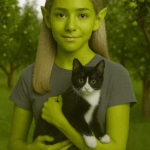
A Family Interview with Kemin Sol and Nira Kam
Global Horizons Interview Series – May 23
Location: Modular Habitat #7B, Freehold construction zone, Missouri Territory
Interviewer: Jaelani Hsu, GlobalNet Cultural Correspondent
JAELANI HSU:
Thank you all for making time. I know your workday started before sunrise.
NIRA KAM:
It still surprises me how early the birds start here. I’m not sure they ever sleep.
KEMIN SOL:
They don’t. They guard territory. So do some of the trees—as our son found out. He tried to challenge a branch to move out of his way. It won.
[Their son, Aven, shrugs and grins. Their daughter, Pina, rolls her eyes.]
JAELANI:
You’re both involved in the new housing expansion just southeast of the Freehold proper. Can you describe what makes these structures different from what you’re used to?
NIRA:
We’re assembling freestanding modular homes—for both species. We’re used to towers, packed tight for efficiency. But here, every family will soon have soil beneath their feet. In a few more weeks: grass. This time next year: fruit trees and gardens.
KEMIN:
I’ve been learning to assemble furniture from a place called Ikea. I think humans have come to expect that “easy to assemble” means “prepare for pain.”
JAELANI:
Is that a V’ren engineering critique?
KEMIN:
It is now.
JAELANI:
You’ve worked mostly with human crews these past few days. What’s that collaboration been like?
NIRA:
No one pretends it’s easy. We speak in shades of meaning. We misunderstand. But we’re learning. Next week I’ll shift to training more of my own people—as I was trained. I’ve been in construction my entire adult life. I take pride in learning fast. I don’t just want to train other V’ren. I want to lead mixed crews—on any project, with anyone.
KEMIN:
There’s a rhythm to building things. Once you find it, caste doesn’t matter. You either move material, or you don’t. And if you don’t—someone hands you a shovel.
JAELANI:
Your children have been volunteering at the Freehold school. How are they adjusting?
PINA:
The little girls braid my hair and ask if it glows. I say yes, just to be mischievous.
AVEN:
They made me play a game where you throw corn bags into a hole. I lost. Badly. To small children. I look forward to having children of my own who play such games.
JAELANI:
Has anything on Earth surprised you?
NIRA:
The trees. The smell after rain. How dirt sticks to your clothes and doesn’t want to come off.
PINA:
The way human girls can be kind to you and terrifying at the same time—especially about relationships.
AVEN:
Your gravity makes our bones ache at the end of the day. But I liked floating in the pool. I want to learn how to swim.
JAELANI:
What do you miss most from home?
KEMIN:
Our sunrise—the long red light that seeps through clouds.
NIRA:
The lower gravity.
PINA:
The taste of nightfruit. We plan to plant it in the remembrance gardens.
AVEN:
My old friends. But I’m making new ones.
JAELANI:
And what have you already come to love about this place?
NIRA:
That our children are safe.
KEMIN:
That someone gave us tools—and said, “Start here.”
JAELANI:
Last question. If you could leave one message for both your people and ours, what would it be?
NIRA:
Don’t just coexist. Co-create.
KEMIN:
A house is not a home until you hear laughter echo inside it.
AVEN:
And build the roof before the rain.
PINA:
And never trust the squirrel-things.
[Laughter. Nira kisses her daughter’s head.]
JAELANI:
Thank you, all of you. May your house be strong and full of light.
KEMIN:
And yours.
NIRA:
Peace to your table.