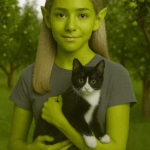
Creswell Bourbon Longuepée and Flal Wath choose pizza, carnival games, and an ordinary future
Pleasure Park, May 15, 2440
Creswell Bourbon Longuepée could be upstairs with the diplomats, executives, academics, and hereditary powers gathered for Matthew Johnathan Boone Marmaduke’s first-contact press junket.
Instead, he sits beneath a food-court awning at Pleasure Park, sharing a pizza with Flal Wath, the V’ren woman who moved into his South Park apartment five days ago.
“The hoi oligoi can survive without me,” he says, watching a child miss spectacularly at a ring-toss booth. “There are no carnie games up there.”
The phrase sounds natural in his mouth. With a name like Bourbon Longuepée, pretension is less an affectation than an inheritance.
Flal pulls the pizza closer before he can take another slice.
Jalapeño, onion, and tocino. Her order.
“You have had enough,” she tells him.
“I paid for it.”
“You bought it to share.”
“I remain involved in the sharing.”
“You ate most of it.”
Creswell looks at the empty spaces on the tray, considers the evidence, and lets the matter drop.
Flal has been on Earth for less than two weeks and already knows which pizza she wants, where she sleeps, and which room in Creswell’s apartment contains too many guns.
It is difficult to imagine a more ordinary sign of arrival.
A man who prefers neighbors
Creswell lives in a two-bedroom apartment in South Park.
He could afford more space. His family connections alone could place him almost anywhere. He could live at the Homestead, on rural acreage, or somewhere quiet enough that visitors would need a reason and directions.
He chooses an apartment.
“A lot of veterans want isolation,” he says. “They want trees, a long road, and no one close enough to arrive uninvited. I wanted people around.”
Flal glances at him.
“He complains about them.”
“I complain about individuals. I remain broadly supportive of the species.”
He likes knowing somebody will notice if he disappears for three days. He likes hearing children outside. He likes walking to shops and seeing the same faces often enough that strangers become neighbors.
He also likes delivery.
“No one brings pizza to a rural address,” he says.
Flal points toward the tray. “This is the true reason.”
“It is one of several sound civic considerations.”
Flal has lived there since May 10.
The apartment’s second bedroom contains firearms, tools, spare parts, cleaning equipment, cases, ammunition, and a chair she insists cannot be reached without stepping over something.
Creswell calls it a workroom.
Flal calls it the gun room.
“Where do your things go?” the interviewer asks.
Flal looks at Creswell.
“He is discovering that.”
“I have offered space.”
“You have identified surfaces.”
“Surfaces are space.”
“They are covered.”
“Some are less covered than others.”
They have known one another for eight days and shared an address for five.
Neither offers an apology for the arithmetic.
Pretty women, language training, and a shotgun barrel
Creswell first enters Flal’s orbit through her younger brother, a technician associated with the neural-interface program.
He wants a language appointment.
He also wants to know whether V’ren fabrication can produce a better competition-shotgun barrel.
According to Flal’s brother, he asks about the women first.
“I asked several questions,” Creswell says.
“In order,” Flal replies. “Pretty women. Language. Shotgun.”
“The sequence has been editorialized.”
“My brother remembers clearly.”
“He enjoys causing trouble.”
“Did you ask if the women were pretty?”
Creswell takes a drink and looks toward the midway.
“Nope. It was obvious.”
Flal smiles with the satisfaction of someone who has already won and sees no need to continue.
Her mother, a former V’ren space marine and armorer, hears about the shotgun question. That earns Creswell an introduction far more quickly than his interest in language does.
“More like she was there when I showed up with beer so I could talk with Jena. She kept trying to get my attention which I was more than happy to give her.”
They talk weapons. They visit the range. Flal joins them. Later, she returns with four coworkers.
“Trap shooting is fun,” she says.
“I’m also there.”
She likes the report of the gun and the clean destruction of the clay target. Success is unmistakable. A target either breaks or it does not.
“He makes a face when I do well,” Flal says.
“I evaluate.”
“You make the face first.”
“This must be a woman thing, all the local aunties tell stories that a man came and made a funny face.”
His range is where flirtation, professional judgment, and local pest control begin to overlap.
Within days, Creswell, Flal, and her coworkers spend two outings hunting razorbacks. They deliver eighteen animals to the Freehold’s butchers, where the meat joins preparations for this press junket’s tables.
“Matt owes us for eighteen pigs,” Creswell says.
“He feeds us,” Flal replies.
“Separate account.”
“He supplies ammunition.”
“Operational expense.”
“He gives us places to sleep.”
Creswell looks at her.
“You live with me.”
“Yes. He gives the others places to sleep.”
“Hospitality.”
“The pigs live on his land.”
“The pigs appear not to recognize his title.”
Flal shakes her head.
“He wants to invoice the Freeholder.”
“I want accurate accounting. It buys more pizzas for her.”
The call from the house
On May 13, Creswell and the five V’ren shooters are at the Homestead.
They have not assembled for an operation. They are in the staff kitchen because they have been shooting and hunting, and because the staff kitchen feeds people who arrive hungry at inconvenient hours.
“They do brain sandwiches right,” Creswell says. “Not too many places can do that.”
Then Marmaduke’s voice comes over the house system.
A Freehold enforcement action is imminent. Qualified citizens have ten minutes to report for an armory draw.
Creswell stands.
The five V’ren stand with him.
There is no speech.
“We hear the call,” Flal says. “We go.”
She and her coworkers swore their Freehold oaths the previous afternoon.
The interviewer asks whether one day is enough time for an oath to become real.
Flal looks almost puzzled by the question.
“We did not cross space to remain nowhere,” she says. “This is our home. Someone in it needs help.”
At the armory, Creswell vouches for them.
“I had watched them shoot,” he says. “I had watched them handle weapons when they were tired, excited, frustrated, and moving around other people. That tells you more than a good score.”
His Amazon Gendermarie in the Newark Garrison taught him how quickly ordinary disorder becomes dangerous. His years as an armorer taught him that confidence and competence are not the same thing.
“If I vouch for someone, Matt is entitled to act on that,” he says. “I had better be right.”
Flal watches him across the table.
“You would not have taken me if you thought I could not do it.”
“No.”
“You would not have taken me if you thought I would die.”
“Any of us could have died. That is the nature of these actions. I would not have taken you if I thought you would get someone else killed.”
Flal holds his gaze, then reaches for the last piece of pizza.
Creswell refuses the title of combat veteran.
“Breaking up bar fights is not combat,” he says. “The people who have lived through combat know that. I am not borrowing it.”
Flal studies him across the table.
“He says what he has done,” she says. “He does not add more.”
“That is a low standard.”
“It is not.”
“What do you want your life here to look like?” the interviewer asks.
Flal considers the midway, the food stalls, and Creswell beside her.
“Busy,” she says.
Creswell smiles.
The people downstairs
The formal junket continues above them.
There are policy interviews to conduct, technical briefings to attend, and powerful people to reassure. Those conversations will determine treaties, money, jurisdiction, and access to technology.
They matter.
So does this.
Creswell chooses the food court because he likes people and because the carnival games are downstairs. Flal chooses a pizza whose ingredients would have sounded meaningless to her two weeks ago. Five days after moving into his apartment, she already disputes his use of an entire bedroom and knows exactly how much pizza he has eaten.
Two days earlier, they answered an armed call together.
Today they argue about onions, storage, and the last slice.
Flal stands and picks up the stuffed prize Creswell won at the bottle game.
He follows her toward the midway.
The hoi oligoi remain upstairs.
There are still games to lose down here.
Curated Social Media Responses:
Positive:
- @MaisieHart, Arrow Rock: Creswell Bourbon Longuepée had access to the important people upstairs and chose pizza and carnival games. That is either excellent judgment or the most Marmaduke thing a non-Marmaduke has ever done.
- @TheRealCreswell: It takes one to know one, cuz…
- @ArrowRockTattler: Five days living together, eight days acquainted, one bedroom already under dispute. Flal Wath appears to understand household government perfectly.
- @KriegerLittleton: The important part is not that Flal answered the armory call. It is that nobody at the Freehold treated her oath as decorative when she did.
- @BooneCountyRangeTalk: Creswell watched them shoot tired, distracted, and around other people before vouching for them. That is how you evaluate safe gun handling. A perfect target tells you less than people think.
- @PleasureParkMidway: For the record, the stuffed animal was won fairly. Whether Creswell could win a second one remains unproven.
- @ColumbiaCommons: The Freehold’s first-contact junket has hereditary rulers upstairs and a V’ren woman downstairs fighting over tocino pizza. Naturally, the pizza story is the one everyone is sharing.
- @RollaLedger: “We did not cross space to remain nowhere” may be the clearest explanation yet of why the V’ren are accepting Freehold citizenship so quickly.
- @SedaliaStockman: Eighteen razorbacks removed in two outings. Welcome to Missouri, Flal. You are already contributing more than half the people complaining about you.
- @HannibalCivicReview: There is a serious political point beneath the carnival story. The Freehold offered the newcomers an oath with immediate standing, then trusted them when the oath was tested.
- @StJoeNeighborhoodWatch: Creswell choosing an apartment because he wants neighbors is the detail that stayed with me. A lot of people claim they value community. He arranged his life so community can inconvenience him.
- @LittleEgyptDispatch: A V’ren former refugee deciding she wants her future to be “busy” is more persuasive than another thousand-word government statement about successful integration.
- @IowaAgrarian: The pigs do not recognize Marmaduke’s title, but apparently Creswell expects his invoice department to.
- @ChicagoSouthSideWire: South Park apartment, gun room, pizza delivery, new girlfriend reorganizing the place within five days. First contact has officially become neighborhood business.
- @TwinCitiesVeteran: “Breaking up bar fights is not combat. I am not borrowing it.” That is how a veteran speaks when he respects the people who carried more than he did.
- @OzarksMutualAid: The five V’ren did not answer because they were ordered to prove loyalty. They heard that someone in their new home needed help and went. That distinction matters.
- @SeattleCivicDesk: The best first-contact reporting is apparently not about propulsion or diplomacy. It is about who gets the second bedroom and whether covered surfaces count as available storage.
- @NewfoundlandHomebound: Flal crossed interstellar space and within days found a home, work, friends, a favorite pizza, and a man with too many guns. Efficient woman.
- @TorontoPluralHouseholds: Nobody in the article pauses to ask whether moving in after three days is respectable. They ask where her belongings will go. Civilization advances.
- @MexicoCityFutureNow: The striking part is how little performance there is. She takes the oath, answers the call, argues about food, and names the future she wants. Busy.
- @HavanaPublicSquare: The people upstairs are negotiating history. The people downstairs are already living in it.
- @GlasgowCommonToll: Creswell says there are no carnival games upstairs. Correct. The upper classes generally dislike games where the rules are visible and prizes must actually be awarded.
- @MJ_Truth_Teller: 🙄🙄🙄
- @WarsawReconstruction: A home is not only shelter. It is the place where you acquire duties, irritations, share storage, and somebody who notices when you disappear. This article understands that.
- @NairobiCivicLife: The Freehold’s advantage is not simply land or wealth. It gives displaced people an immediate route from guest to participant.
- @ManilaNightDesk: Pretty women, language training, shotgun fabrication, then moving in together. Creswell’s priorities were chaotic, but apparently operationally successful.
- @OsakaHumanVrenForum: Flal’s mother spoke guns with him before the relationship advanced. Across species and centuries, meeting the family remains the serious stage.
Neutral:
- @BuenosAiresWorldDesk: The article is less about first contact than about how quickly extraordinary circumstances become domestic routine. That may be its most useful contribution.
- @CapeTownObserver: Creswell’s refusal to call himself a combat veteran is more revealing than the carnival material. He seems careful about the limits of his own authority and experience.
- @DelhiPublicForum: Moving into someone’s apartment after three days is certainly efficient. The article treats it as settled fact rather than controversy, which is probably the correct reporting choice.
- @SeoulCivicReview: Flal’s answer, “Busy,” is notable because it is modest. She does not claim to represent the V’ren or offer a grand theory of resettlement.
- @SãoPauloMorningWire: The Freehold appears to integrate people through immediate participation rather than prolonged orientation. Whether that model works at scale remains an open question.
- @StockholmHouseholdStudies: The second bedroom dispute may be the most ordinary part of the article. Shared housing becomes real when storage begins to matter.
- @LagosWorldMonitor: The armed-response section changes the piece substantially. Without it, this would be a light relationship profile. With it, the article becomes partly about citizenship and institutional trust.
- @PragueDailyContext: Creswell’s judgment of the five shooters seems based on repeated practical observation, not a single range score. That distinction is important.
- @FloydReyes: He is a top-notch instructor and safety officer. I would not have certified him as Range Master if he wasn’t.
- @JakartaGlobalView: The article gives little detail about the actual enforcement action, so readers are being asked to evaluate Creswell and Flal’s participation without the full event context.
- @AucklandPublicRadio: The contrast between officials upstairs and ordinary activity downstairs is effective, though it is also a familiar feature-writing device. The characters make it feel specific.
Negative/Trolls
- @LondonRepublicNow: A hereditary rich man skips one elite room for another part of his family’s private amusement park and we are supposed to call this class solidarity.
- @OrbitalTruthFeed: Eight days acquainted, five days living together, armed patrol by day six. Nothing alarming here. Completely normal first-contact governance.
- @ParisAntiFeudal: The Freeholder gives refugees housing, guns, and oaths, then his relatives write charming articles about how grateful and busy everyone is. Very organic.
- @SydneySkeptic88: She crossed space, met a man with a gun room, moved in immediately, and joined an armed action. This reads less like integration and more like the opening of a cult documentary.
- @GlasgowClassWar: “Hoi oligoi” is a cute joke until you remember he is literally hereditary wealth sitting in a private theme park discussing which aristocrat owes him for dead pigs.
- @TomCreyton: It is easy to forget how petty poor people are, when your country doesn’t have any SMH 🤷🏾♂️ Minimum wage here is the global median household income. Think I will go grill a steak #realmeat #affordabilityindex #hoipoloibbq #FreeholdForever
Currated Media Responses
The Freehold’s Citizenship Means Something Because It Is Not Automatic
The most important line in “Life at the Freehold” is not about pizza, guns, or rapid cohabitation. It is Flal Wath’s explanation for answering the armory call: “We did not cross space to remain nowhere. This is our home. Someone in it needs help.”
Critics have treated that loyalty as manufactured because the V’ren received housing, residency, and institutional protection. That argument ignores how carefully the Freehold distinguishes hospitality from citizenship.
Matthew Johnathan Boone Marmaduke granted residency across the V’ren population arriving on his personally owned lands. He had to. The Freehold and his other territories are private property, and no other government can independently grant someone standing there.
Citizenship was different.
Only 219 V’ren received it at that time, in gratitude for the care they gave the Freeholder’s kin during the Hart farm accident. Personal sponsorship by a Freeholder is rare. Sponsoring hundreds at once is almost without precedent. In nearly thirty years holding the office, Matthew had personally bestowed citizenship on only one other person, his late wife. Even she did not become a citizen merely by marrying him.
That context matters when Flal says the oath was real after one day. She was not handed a decorative document as part of a publicity campaign. She belonged to a limited group publicly recognized for service already rendered.
The Glasgow exchange also exposes the weakness of the class critique. Yes, Creswell possesses hereditary wealth and is sitting inside a privately owned amusement park. Tom Creyton’s answer is crude but relevant: Freehold minimum wage equals the global median household income. Material comfort is not reserved for Creswell’s class.
The Freehold is unequal. It is not poor. Those are not the same accusation.
Flal did not answer because she had nowhere else to go. She answered because the place that received her had already allowed her to become someone who could stand up when called.
- @DelhiCivicReview: The article’s strongest point is that the oath followed recognition, not desperation. Flal had residency already. Citizenship marked service rendered, and that gives her answer about home considerably more weight.
- @DaveRoxas: We are proud to call them neighbors and citizens. This time next year there will be more. The year after that, even more.
- @ParisRepublicNow: Scarcity can make citizenship meaningful, but it also makes the Freeholder’s discretion more consequential. The grant to 219 caregivers may be admirable while the concentration of that authority remains worth watching.
- @MJ_Truth_Teller: 🙄🙄🙄
- @MonkayoPublicForum: The late wife detail matters. Marriage did not automatically make her a citizen, and Matthew personally sponsored only her before this group. That makes the V’ren grant look less like favoritism and more like an extraordinary response to extraordinary service.
- @NairobiHouseholdEconomics: “Unequal” and “poor” are not interchangeable. A society can be openly hierarchical while still giving ordinary residents wages, recreation, food, housing, and security unavailable to nominal citizens elsewhere.
- @FreeholdHR: maybe don’t pass on the recruitment drive should we ever decide to offer one again…
- @OsakaHumanVrenForum: Flal did not say the Freehold was perfect. She said it was home and someone there needed help. After crossing interstellar space, being granted residency, caring for injured kin, and receiving citizenship, that is not manufactured loyalty. It is reciprocity.
Residency, Citizenship, and the Speed of Belonging
“Life at the Freehold” succeeds as a relationship profile because it allows ordinary details to carry political meaning. Pizza preferences, apartment storage, range habits, and carnival games show how quickly Flal Wath has begun forming a life on Earth.
The armed-response section, however, requires more institutional context than the original article provides.
Matthew Johnathan Boone Marmaduke granted residency to the wider V’ren population upon their arrival in the Freehold. Because the Freehold and his other personally held lands are private property, he alone can grant that standing within them. Residency therefore reflects his willingness to receive the newcomers, but it does not make them Freehold citizens.
At that stage, only 219 V’ren had received citizenship. Their sponsorship followed the Hart farm accident, during which they provided care to members of the Freeholder’s extended family. Citizenship was granted in gratitude for that service.
This was unusual. Freeholders rarely sponsor citizens personally, and en masse sponsorship is rarer still. In almost thirty years, Matthew had personally bestowed citizenship on only one previous individual, his late wife. Marriage itself had not granted her citizenship.
Flal’s oath therefore had institutional weight, even though it was new. Her answer that she had not crossed space “to remain nowhere” should be understood as a claim to immediate belonging, not evidence that all V’ren had been rapidly absorbed into the citizen body.
The social argument about class is less easily settled. GlasgowClassWar is correct that Creswell is a wealthy hereditary figure relaxing in a family-owned park. Tom Creyton is also correct that Freehold wages make conventional poverty comparisons difficult.
Both observations can be true. The Freehold remains hierarchical, but its hierarchy operates inside broadly distributed material security.
The article’s value lies in showing how that political arrangement feels at ground level. Whether it scales beyond the first 219 citizens remains an open question.
- @ChicagoFoodEconomy: Calling Pleasure Park an elite enclave because it is privately owned misses the actual access model. A $10 day pass includes rides, water park, roller rink, ice rink, skatepark, climbing gym, arcades, lounges, and more. Ownership and exclusivity are not synonyms.
- @BostonConsumerWatch: The food comparison is brutal. Arrow Rock porterhouse at $20 fita per kilo, artificial steak in Boston at $75 per pound, and real porterhouse in Chicago at $300 per pound by lottery. Whatever else the Freehold is, its ordinary workers are not being priced out of ordinary pleasures.
- @GlasgowClassWar: Fine, the park is affordable. That still does not make hereditary wealth democratic. It does, however, make “rich man visits private amusement park” a weaker criticism when local teenagers can buy admission from one part-time shift and most workers enter through employment passes.
- @SãoPauloUrbanLife: The annual and employment passes matter more than the headline day price. Pleasure Park appears to function as civic recreation infrastructure despite private ownership. Residents use it the way other cities use municipal pools, sports centers, parks, and youth clubs, only combined.
- @OsakaLeisureReview: A $10 general pass covering both ice and roller skating, rides, water facilities, climbing, arcades, lounges, and a skatepark is not luxury pricing. Go-karts, the drone course, and the separate fitness center costing extra does not meaningfully change that.
- @NairobiHouseholdEconomics: “Broadly distributed material security” may be too cautious. When part-time teenagers can afford major recreation and working households can buy real porterhouse as ordinary food, the Freehold is distributing access to goods that many richer-looking states reserve for elites.
- @TomCreyton: They keep calling it a private theme park like we are pressed against the fence watching Creswell eat. Ten fiat gets you nearly everything, my work pass gets me in free, and steak costs less than Fake Steak in Boston. Please continue explaining my oppression while I decide between the water slide and the roller rink. #FreeholdForever
A Charming Profile Does Not Resolve the Freehold’s Power Problem
“Life at the Freehold” is effective reporting because Creswell Bourbon Longuepée and Flal Wath are likable. It is less successful when readers treat their likability as an answer to questions about authority.
The social responses correctly note that Flal’s oath was not merely decorative. Only 219 V’ren received citizenship at that stage, following their care for the Freeholder’s relatives during the Hart farm accident. Matthew Johnathan Boone Marmaduke rarely grants citizenship personally. In nearly thirty years, the only prior person he personally sponsored was his late wife, who did not receive citizenship automatically through marriage.
That scarcity gives the honor significance. It also reveals the concentration of power.
The wider V’ren population received residency because Matthew allowed them to live on the Freehold and his other personally owned lands. Since those territories are private property, he alone can grant such standing. Their security therefore depends on the continuing judgment of one proprietor-sovereign.
GlasgowClassWar’s criticism should not be dismissed simply because Tom Creyton can answer that Freehold minimum wage equals the global median household income. High wages may reduce exploitation and desperation. They do not erase hierarchy.
Creswell remains a man of inherited wealth sitting in his family’s private amusement park, joking about billing an aristocratic cousin for pigs killed on that cousin’s land. The fact that ordinary workers can also afford steak makes the arrangement materially generous, not politically egalitarian.
Flal may sincerely love her new home. Her decision to answer the call may be entirely voluntary. Neither fact answers whether a system is healthy when residence, citizenship, employment, housing, armed obligation, and territorial permission all converge around one family and one office.
The article shows belonging happening quickly. It does not prove that belonging is secure independently of Matthew’s continued goodwill.
That distinction is worth preserving, even while admitting the pizza story is charming.
- @DelhiConstitutionalReview: The Freehold’s sponsorship model is being described as uniquely feudal when seven states use essentially the same executive-approval system. Vatican City, Andorra, Alsace, Monaco, and the Freehold are not identical governments, but citizenship by sponsorship is hardly unprecedented.
- @SãoPauloCivicData: Only one country in 2440, Brazil, still grants unrestricted birthright citizenship. Two limit it to the first son and daughter, and five more to the first two or three children. The Freehold is not the global outlier people seem to think it is.
- @SeoulMigrationDesk: About 45 percent of states require a residency period before naturalization, but most of those systems let the executive waive it. Matthew Boone Marmaduke sponsoring 219 V’ren at once is unusual in scale, not unusual in legal mechanism.
- @NairobiPublicLaw: A quarter of countries transmit citizenship through a citizen parent. That means three quarters do not treat ancestry alone as sufficient. The claim that citizenship must automatically follow birth or blood is culturally specific, not universal.
- @WarsawStatecraft: Eighty-four percent of countries distinguish youth citizenship from adult citizenship, often with sharply reduced rights before the age threshold. The Freehold’s controlled citizenship is not stranger than systems that call children citizens while denying them most political standing.
- @BuenosAiresWorldDesk: The interesting question is not whether the Freeholder approves citizenship personally. Executives waive residence rules, confirm sponsors, and grant exceptional citizenship all over the world. The question is how consistently he uses that power.
- @GenSanLegalForum: The CCC makes the entire argument even less dramatic. Member corporations can grant citizenship under their own charters, including by purchase. Nearly one in eight nation-states still offers some form of citizenship-by-investment program.
- @GlasgowCivicArchive: I dislike hereditary government, but pretending the Freehold invented discretionary citizenship is unserious. Most countries abandoned full birthright citizenship generations ago, often while retaining far less generous labor standards.
- @ParisRepublicNow: Executive approval remains executive approval, even when common. The Freehold is not uniquely authoritarian, but “other countries do it too” is not a defense of concentrated power. It is evidence that concentrated power is widespread.
- @TorontoPluralCitizenship: Residency for the wider V’ren population and citizenship for 219 recognized caregivers looks remarkably conventional. States routinely separate lawful residence, permanent residence, naturalization eligibility, and citizenship.
- @CairoComparativeLaw: Sponsorship-only citizenship sounds archaic until one remembers that several small states preserve it because unrestricted citizenship would overwhelm their political system. The Freehold has similar concerns about land, jurisdiction, and succession.
- @OsakaHumanVrenForum: The notable act was not that Matthew possessed the authority to grant citizenship. Many executives do. It was that he used a rarely exercised personal sponsorship power for 219 refugees after they cared for his injured kin.
- @CapeTownObserver: People keep treating marriage as an automatic route to citizenship. In much of the world it is not. Matthew’s late wife requiring personal sponsorship rather than acquiring citizenship through marriage fits a broad international pattern.
- @MexicoCityFutureNow: The Freehold looks less exceptional the more comparative data appears. Restricted birthright rules, parental transmission limits, residence periods, executive waivers, age controls, and paid citizenship programs are all normal features of 2440 nationality law.
- @TomCreyton: So the scandal is that the Freehold has citizenship rules like everybody else, except the workers make more, refugees got residency immediately, and 219 caregivers got personally sponsored after saving family members. Devastating stuff. #FreeholdForever